Indian Rebellion of 1857
From Wikipedia, the free encyclopedia
(Redirected from Indian rebellion of 1857)
"Sepoy Mutiny" redirects here. For other uses, see Sepoy Mutiny (disambiguation).
|
||||||||||||||||||||||


|
Part of a series on the
|
|---|
| History of India |
 |
Other regions of Company-controlled India, the Bombay Presidency, and the Madras Presidency remained largely calm. The large princely states of Hyderabad, Mysore, Travancore, and Kashmir, as well as the smaller ones of Rajputana, did not join the rebellion. In some regions, such as Oudh, the rebellion took on the attributes of a patriotic revolt against European presence.[8] Some rebel leaders, such as Lakshmibai, the Rani of Jhansi, became folk heroes in the nationalist movement in India half a century later.[6] In the Bengal Presidency, the revolt was entirely centred on Bihar which experienced multiple disturbances in the Shahabad region where the revolt was led by Kunwar Singh.[6][9] In Punjab, the Sikh princes backed the Company by providing soldiers and support.[6]
The rebellion led to the dissolution of the East India Company in 1858. It also led the British to reorganise the army, the financial system and the administration in India.[10] The country was thereafter directly governed by the crown as the new British Raj.[11]
Contents
East India Company's expansion in India
Main article: Company rule in India

India in 1837 and 1857 showing East India Company (pink) and other territories
In 1806, the Vellore Mutiny was sparked by new uniform regulations that created resentment amongst both Hindu and Muslim sepoys.[15]
After the turn of the 19th century, Governor-General Wellesley began what became two decades of accelerated expansion of Company territories.[16] This was achieved either by subsidiary alliances between the Company and local rulers or by direct military annexation. The subsidiary alliances created the princely states of the Hindu maharajas and the Muslim nawabs. Punjab, North-West Frontier Province, and Kashmir were annexed after the Second Anglo-Sikh War in 1849; however, Kashmir was immediately sold under the 1846 Treaty of Amritsar to the Dogra Dynasty of Jammu and thereby became a princely state. The border dispute between Nepal and British India, which sharpened after 1801, had caused the Anglo-Nepalese War of 1814–16 and brought the defeated Gurkhas under British influence. In 1854, Berar was annexed, and the state of Oudh was added two years later. For practical purposes, the Company was the government of much of India.[17]
Causes of the rebellion
Main article: Causes of the Indian Rebellion of 1857
The Indian Rebellion of 1857 occurred as the result of an accumulation of factors over time, rather than any single event.The sepoys were local soldiers, the majority Hindus or Muslims, who were recruited into the Company's army. Just before the rebellion, there were over 300,000 sepoys in the army, compared to about 50,000 British. The forces were divided into three presidency armies: Bombay, Madras, and Bengal. The Bengal Army recruited higher castes, such as Rajputs and Bhumihar, mostly from the Awadh and Bihar regions, and even restricted the enlistment of lower castes in 1855. In contrast, the Madras Army and Bombay Army were "more localized, caste-neutral armies" that "did not prefer high-caste men."[18] The domination of higher castes in the Bengal Army has been blamed in part for initial mutinies that led to the rebellion.

Two sepoy officers; a private sepoy, 1820s
After the annexation of Oudh (Awadh) by the East India Company in 1856, many sepoys were disquieted both from losing their perquisites, as landed gentry, in the Oudh courts, and from the anticipation of any increased land-revenue payments that the annexation might bring about.[21] Other historians have stressed that by 1857, some Indian soldiers, interpreting the presence of missionaries as a sign of official intent, were convinced that the Company was masterminding mass conversions of Hindus and Muslims to Christianity.[22] Although earlier in the 1830s, evangelicals such as William Carey and William Wilberforce had successfully clamoured for the passage of social reform, such as the abolition of sati and allowing the remarriage of Hindu widows, there is little evidence that the sepoys' allegiance was affected by this.[21]
However, changes in the terms of their professional service may have created resentment. As the extent of the East India Company's jurisdiction expanded with victories in wars or annexation, the soldiers were now expected not only to serve in less familiar regions, such as in Burma, but also to make do without the "foreign service" remuneration that had previously been their due.[23]
A major cause of resentment that arose ten months prior to the outbreak of the rebellion was the General Service Enlistment Act of 25 July 1856. As noted above, men of the Bengal Army had been exempted from overseas service. Specifically, they were enlisted only for service in territories to which they could march. Governor-General Lord Dalhousie saw this as an anomaly, since all sepoys of the Madras and Bombay Armies and the six "General Service" battalions of the Bengal Army had accepted an obligation to serve overseas if required. As a result, the burden of providing contingents for active service in Burma, readily accessible only by sea, and China had fallen disproportionately on the two smaller Presidency Armies. As signed into effect by Lord Canning, Dalhousie's successor as Governor-General, the act required only new recruits to the Bengal Army to accept a commitment for general service. However, serving high-caste sepoys were fearful that it would be eventually extended to them, as well as preventing sons following fathers into an army with a strong tradition of family service.[24]
There were also grievances over the issue of promotions, based on seniority. This, as well as the increasing number of European officers in the battalions,[25] made promotion slow, and many Indian officers did not reach commissioned rank until they were too old to be effective.[26]
Tallow and lard-greased cartridges
The final spark was provided by the ammunition for the new Enfield P-53 rifle.[27] These rifles, which fired Minié balls, had a tighter fit than the earlier muskets, and used paper cartridges that came pre-greased. To load the rifle, sepoys had to bite the cartridge open to release the powder.[28] The grease used on these cartridges was rumoured to include tallow derived from beef, which would be offensive to Hindus,[29] and pork, which would be offensive to Muslims. At least one Company official pointed out the difficulties this may cause:unless it be proven that the grease employed in these cartridges is not of a nature to offend or interfere with the prejudices of caste, it will be expedient not to issue them for test to Native corps.[30]However, in August 1856, greased cartridge production was initiated at Fort William, Calcutta, following a British design. The grease used included tallow supplied by the Indian firm of Gangadarh Banerji & Co.[31] By January, rumours were abroad that the Enfield cartridges were greased with animal fat.
Company officers became aware of the rumours through reports of an altercation between a high-caste sepoy and a low-caste labourer at Dum Dum.[32] The labourer had taunted the sepoy that by biting the cartridge, he had himself lost caste, although at this time such cartridges had been issued only at Meerut and not at Dum Dum.[33] There had been rumours that the British sought to destroy the religions of the Indian people, and forcing the native soldiers to break their sacred code would have certainly added to this rumour, as it apparently did. The Company was quick to reverse the effects of this policy in hopes that the unrest would be quelled.[34][35]
On 27 January, Colonel Richard Birch, the Military Secretary, ordered that all cartridges issued from depots were to be free from grease, and that sepoys could grease them themselves using whatever mixture "they may prefer".[36] A modification was also made to the drill for loading so that the cartridge was torn with the hands and not bitten. This however, merely caused many sepoys to be convinced that the rumours were true and that their fears were justified. Additional rumours started that the paper in the new cartridges, which was glazed and stiffer than the previously used paper, was impregnated with grease.[37] In February, a court of inquiry was held at Barrackpore to get to the bottom of these rumours. Native soldiers called as witnesses complained of the paper "being stiff and like cloth in the mode of tearing", said that when the paper was burned it smelled of grease, and announced that the suspicion that the paper itself contained grease could not be removed from their minds.[38]
Civilian disquiet
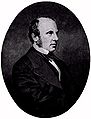
The civilian rebellion was more multifarious. The rebels consisted of three groups: the feudal nobility, rural landlords called taluqdars, and the peasants. The nobility, many of whom had lost titles and domains under the Doctrine of Lapse, which refused to recognise the adopted children of princes as legal heirs, felt that the Company had interfered with a traditional system of inheritance. Rebel leaders such as Nana Sahib and the Rani of Jhansi belonged to this group; the latter, for example, was prepared to accept East India Company supremacy if her adopted son was recognised as her late husband's heir.[39] In other areas of central India, such as Indore and Saugar, where such loss of privilege had not occurred, the princes remained loyal to the Company, even in areas where the sepoys had rebelled.[40] The second group, the taluqdars, had lost half their landed estates to peasant farmers as a result of the land reforms that came in the wake of annexation of Oudh. As the rebellion gained ground, the taluqdars quickly reoccupied the lands they had lost, and paradoxically, in part because of ties of kinship and feudal loyalty, did not experience significant opposition from the peasant farmers, many of whom joined the rebellion, to the great dismay of the British.[41] It has also been suggested that heavy land-revenue assessment in some areas by the British resulted in many landowning families either losing their land or going into great debt to money lenders, and providing ultimately a reason to rebel; money lenders, in addition to the Company, were particular objects of the rebels' animosity.[42] The civilian rebellion was also highly uneven in its geographic distribution, even in areas of north-central India that were no longer under British control. For example, the relatively prosperous Muzaffarnagar district, a beneficiary of a Company irrigation scheme, and next door to Meerut, where the upheaval began, stayed mostly calm throughout.[43]-
-

-
 Lakshmibai, the Rani of Maratha-ruled Jhansi, one of the principal leaders of the rebellion who earlier had lost her kingdom as a result of the Doctrine of Lapse.
-
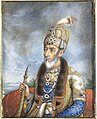 Bahadur Shah Zafar the last Mughal Emperor, crowned Emperor of India, by the Indian troops, he was deposed by the British, and died in exile in Burma


Sir Syed Ahmed Khan, founder of the Muhammedan Anglo-Oriental College, later the Aligarh Muslim University, wrote one of the early critiques, The Causes of the Indian Mutiny, in 1859.
The justice system was considered to be inherently unfair to the Indians. The official Blue Books, East India (Torture) 1855–1857, laid before the House of Commons during the sessions of 1856 and 1857, revealed that Company officers were allowed an extended series of appeals if convicted or accused of brutality or crimes against Indians.
The economic policies of the East India Company were also resented by many Indians.[50]
The Bengal Army
Each of the three "Presidencies" into which the East India Company divided India for administrative purposes maintained their own armies. Of these, the Army of the Bengal Presidency was the largest. Unlike the other two, it recruited heavily from among high-caste Hindus and comparatively wealthy Muslims. The Muslims formed a larger percentage of the 18 irregular cavalry units[51] within the Bengal army, whilst Hindus were mainly to be found in the 84 regular infantry and cavalry regiments. The sepoys were therefore affected to a large degree by the concerns of the landholding and traditional members of Indian society. In the early years of Company rule, it tolerated and even encouraged the caste privileges and customs within the Bengal Army, which recruited its regular soldiers almost exclusively amongst the landowning Brahmins and Rajputs of the Bihar and Awadh regions. These soldiers were known as Purbiyas. By the time these customs and privileges came to be threatened by modernising regimes in Calcutta from the 1840s onwards, the sepoys had become accustomed to very high ritual status and were extremely sensitive to suggestions that their caste might be polluted.[52]The sepoys also gradually became dissatisfied with various other aspects of army life. Their pay was relatively low and after Awadh and the Punjab were annexed, the soldiers no longer received extra pay (batta or bhatta) for service there, because they were no longer considered "foreign missions". The junior European officers became increasingly estranged from their soldiers, in many cases treating them as their racial inferiors. In 1856, a new Enlistment Act was introduced by the Company, which in theory made every unit in the Bengal Army liable to service overseas. Although it was intended to apply only to new recruits, the serving sepoys feared that the Act might be applied retroactively to them as well.[53] A high-caste Hindu who travelled in the cramped conditions of a wooden troop ship could not cook his own food on his own fire, and accordingly risked losing caste through ritual pollution.[54]
Onset of the Rebellion

Indian Mutiny Map Showing Position of Troops on 1st May 1857
Mangal Pandey
Main article: Mangal Pandey

General John Hearsey came out to the parade ground to investigate, and claimed later that Mangal Pandey was in some kind of "religious frenzy". He ordered the Indian commander of the quarter guard Jemadar Ishwari Prasad to arrest Mangal Pandey, but the Jemadar refused. The quarter guard and other sepoys present, with the single exception of a soldier called Shaikh Paltu, drew back from restraining or arresting Mangal Pandey. Shaikh Paltu restrained Pandey from continuing his attack.[57][58]
After failing to incite his comrades into an open and active rebellion, Mangal Pandey tried to take his own life, by placing his musket to his chest and pulling the trigger with his toe. He managed only to wound himself. Court-martialled on 6 April, he was hanged two days later.
The Jemadar Ishwari Prasad was sentenced to death and hanged on 22 April. The regiment was disbanded and stripped of its uniforms because it was felt that it harboured ill-feelings towards its superiors, particularly after this incident. Shaikh Paltu was promoted to the rank of Jemadar in the Bengal Army.
Sepoys in other regiments thought these punishments were harsh. The demonstration of disgrace during the formal disbanding helped foment the rebellion in view of some historians. Disgruntled ex-sepoys returned home to Awadh with a desire for revenge.
Unrest during April 1857
During April, there was unrest and fires at Agra, Allahabad and Ambala. At Ambala in particular, which was a large military cantonment where several units had been collected for their annual musketry practice, it was clear to General Anson, Commander-in-Chief of the Bengal Army, that some sort of rebellion over the cartridges was imminent. Despite the objections of the civilian Governor-General's staff, he agreed to postpone the musketry practice and allow a new drill by which the soldiers tore the cartridges with their fingers rather than their teeth. However, he issued no general orders making this standard practice throughout the Bengal Army and, rather than remain at Ambala to defuse or overawe potential trouble, he then proceeded to Simla, the cool "hill station" where many high officials spent the summer.Although there was no open revolt at Ambala, there was widespread arson during late April. Barrack buildings (especially those belonging to soldiers who had used the Enfield cartridges) and European officers' bungalows were set on fire.[59]
Meerut

"The Sepoy revolt at Meerut," from the Illustrated London News, 1857

An 1858 photograph by Felice Beato of a mosque in Meerut where some of the rebel soldiers may have prayed
Although the state of unrest within the Bengal Army was well known, on 24 April Lieutenant Colonel George Carmichael-Smyth, the unsympathetic commanding officer of the 3rd Bengal Light Cavalry, ordered 90 of his men to parade and perform firing drills with the new cartridges. All except five of the men on parade refused to accept their cartridges. On 9 May, the remaining 85 men were court martialled, and most were sentenced to 10 years' imprisonment with hard labour. Eleven comparatively young soldiers were given five years' imprisonment. The entire garrison was paraded and watched as the condemned men were stripped of their uniforms and placed in shackles. As they were marched off to jail, the condemned soldiers berated their comrades for failing to support them.
The next day was Sunday. Some Indian soldiers warned off-duty junior European officers that plans were afoot to release the imprisoned soldiers by force, but the senior officers to whom this was reported took no action. There was also unrest in the city of Meerut itself, with angry protests in the bazaar and some buildings being set on fire. In the evening, most European officers were preparing to attend church, while many of the European soldiers were off duty and had gone into canteens or into the bazaar in Meerut. The Indian troops, led by the 3rd Cavalry, broke into revolt. European junior officers who attempted to quell the first outbreaks were killed by the rebels. European officers' and civilians' quarters were attacked, and four civilian men, eight women and eight children were killed. Crowds in the bazaar attacked the off-duty soldiers there. About 50 Indian civilians, some officers' servants who tried to defend or conceal their employers, were also killed by the sepoys.[61] The sepoys freed their 85 imprisoned comrades from the jail, along with 800 other prisoners.[62]
Some sepoys (especially from the 11th Bengal Native Infantry) escorted trusted British officers and women and children to safety before joining the revolt.[63] Some officers and their families escaped to Rampur, where they found refuge with the Nawab.
The British historian Philip Mason notes that it was inevitable that most of the sepoys and sowars from Meerut should have made for Delhi on the night of 10 May. It was a strong walled city located only forty miles away, it was the ancient capital and present seat of the Mughal Emperor and finally there were no British troops in garrison there in contrast to Meerut.[60] No effort was made to pursue them.
Delhi
Early on 11 May, the first parties of the 3rd Cavalry reached Delhi. From beneath the windows of the King's apartments in the palace, they called on him to acknowledge and lead them. Bahadur Shah did nothing at this point, apparently treating the sepoys as ordinary petitioners, but others in the palace were quick to join the revolt. During the day, the revolt spread. European officials and dependents, Indian Christians and shop keepers within the city were killed, some by sepoys and others by crowds of rioters.[64]
The Flagstaff Tower, Delhi, where the European survivors of the rebellion gathered on 11 May 1857; photographed by Felice Beato
Many fugitive European officers and civilians had congregated at the Flagstaff Tower on the ridge north of Delhi, where telegraph operators were sending news of the events to other British stations. When it became clear that the help expected from Meerut was not coming, they made their way in carriages to Karnal. Those who became separated from the main body or who could not reach the Flagstaff Tower also set out for Karnal on foot. Some were helped by villagers on the way; others were killed.
The next day, Bahadur Shah held his first formal court for many years. It was attended by many excited sepoys. The King was alarmed by the turn events had taken, but eventually accepted the sepoys' allegiance and agreed to give his countenance to the rebellion. On 16 May, up to 50 Europeans who had been held prisoner in the palace or had been discovered hiding in the city were killed by some of the King's servants under a peepul tree in a courtyard outside the palace.[66][67]
Supporters and opposition

Troops of the Native Allies by George Francklin Atkinson, 1859.

States during the rebellion
The military authorities also reacted in disjointed manner. Some officers trusted their sepoys, but others tried to disarm them to forestall potential uprisings. At Benares and Allahabad, the disarmings were bungled, also leading to local revolts.[69]
Although rebellion became widespread, there was little unity among the rebels. While Bahadur Shah Zafar was restored to the imperial throne, there was a faction that wanted the Maratha rulers to be enthroned also, and the Awadhis wanted to retain the powers that their Nawab used to have.[citation needed]
There were calls for jihad[70] by Muslim leaders like Maulana Fazl-e-Haq Khairabadi and the millenarian Ahmedullah Shah, which were taken up by Muslims, particularly artisans, which caused the British to think that the Muslims were the main force behind this event. The Mughal emperor, Bahadur Shah, resisted these calls for jihad because, it has been suggested, he feared outbreaks of communal violence. In Awadh, Sunni Muslims did not want to see a return to Shiite rule, so they often refused to join what they perceived to be a Shia rebellion. However, some Muslims, like the Aga Khan, supported the British. The British rewarded him by formally recognising his title.[citation needed]
Although most of the mutinous sepoys in Delhi were Hindus, a significant proportion of the insurgents were Muslims. The proportion of ghazis grew to be about a quarter of the local fighting force by the end of the siege and included a regiment of suicide ghazis from Gwalior who had vowed never to eat again and to fight until they met certain death at the hands of British troops.[71]
In Thana Bhawan, the Sunnis declared Haji Imdadullah their Ameer. In May 1857, the Battle of Shamli took place between the forces of Haji Imdadullah and the British.[citation needed]
The Sikhs and Pathans of the Punjab and North-West Frontier Province supported the British and helped in the recapture of Delhi.[72][73] Historian John Harris has asserted that the Sikhs wanted to avenge the annexation of the Sikh Empire eight years earlier by the Company with the help of Purbiyas ('Easterners'), Biharis and those from the United Provinces of Agra and Oudh who had formed part of the East India Company's armies in the First and Second Anglo-Sikh Wars. He has also suggested that Sikhs felt insulted by the attitude of sepoys who, in their view, had beaten the Khalsa only with British help; they resented and despised them far more than they did the British.[74]
The Sikhs feared reinstatement of Mughal rule in northern India[75] because they had been persecuted heavily in the past by the Mughal dynasty.

Sikh Troops Dividing the Spoil Taken from Mutineers, circa 1860.
In 1857, the Bengal Army had 86,000 men, of which 12,000 were European, 16,000 Sikh and 1,500 Gurkha. There were 311,000 native soldiers in India altogether, 40,160 European soldiers and 5,362 officers.[76] Fifty-four of the Bengal Army's 74 regular Native Infantry Regiments mutinied, but some were immediately destroyed or broke up, with their sepoys drifting away to their homes. A number of the remaining 20 regiments were disarmed or disbanded to prevent or forestall mutiny. In total, only twelve of the original Bengal Native Infantry regiments survived to pass into the new Indian Army.[77] All ten of the Bengal Light Cavalry regiments mutinied.
The Bengal Army also consisted of 29 irregular cavalry and 42 irregular infantry regiments. Of these, there was a substantial contingent from the recently annexed state of Awadh, which mutinied en masse. Another large contingent from Gwalior also mutinied, even though that state's ruler supported the British. The remainder of the irregular units were raised from a wide variety of sources and were less affected by the concerns of mainstream Indian society. Some irregular units actively supported the Company: three Gurkha and five of six Sikh infantry units, and the six infantry and six cavalry units of the recently raised Punjab Irregular Force.[78][79]
On 1 April 1858, the number of Indian soldiers in the Bengal army loyal to the Company was 80,053.[80][81] However large numbers were hastily raised in the Punjab and North-West Frontier after the outbreak of the Rebellion. The Bombay army had three mutinies in its 29 regiments, whilst the Madras army had none at all, although elements of one of its 52 regiments refused to volunteer for service in Bengal.[82] Nonetheless, most of southern India remained passive, with only intermittent outbreaks of violence. Many parts of the region were ruled by the Nizams or the Mysore royalty, and were thus not directly under British rule.
The Revolt
Initial stages

Fugitive British officers and their families attacked by mutineers.
Initially, the Indian rebels were able to push back Company forces, and captured several important towns in Haryana, Bihar, the Central Provinces and the United Provinces. When European troops were reinforced and began to counterattack, the mutineers were especially handicapped by their lack of centralized command and control. Although the rebels produced some natural leaders such as Bakht Khan, whom the Emperor later nominated as commander-in-chief after his son Mirza Mughal proved ineffectual, for the most part they were forced to look for leadership to rajahs and princes. Some of these were to prove dedicated leaders, but others were self-interested or inept.
In the countryside around Meerut, a general Gurjar uprising posed the largest threat to the British. In Parikshitgarh near Meerut, Gurjars declared Choudhari Kadam Singh (Kuddum Singh) their leader, and expelled Company police. Kadam Singh Gurjar led a large force, estimates varying from 2,000 to 10,000.[85] Bulandshahr and Bijnor also came under the control of Gurjars under Walidad Khan and Maho Singh respectively. Contemporary sources report that nearly all the Gurjar villages between Meerut and Delhi participated in the revolt, in some cases with support from Jullundur, and it was not until late July that, with the help of local Jats, the British managed to regain control of the area.[85]

Attack of the mutineers on the Redan Battery at Lucknow, 30 July 1857
Mufti Nizamuddin, a renowned scholar of Lahore, issued a Fatwa against the British forces and called upon the local population to support the forces of Rao Tula Ram. Casualties were high at the subsequent engagement at Narnaul (Nasibpur). After the defeat of Rao Tula Ram on 16 November 1857, Mufti Nizamuddin was arrested, and his brother Mufti Yaqinuddin and brother-in-law Abdur Rahman (alias Nabi Baksh) were arrested in Tijara. They were taken to Delhi and hanged.[87] Having lost the fight at Nasibpur, Rao Tula Ram and Pran Sukh Yadav requested arms from Russia, which had just been engaged against Britain in the Crimean War.
Delhi
Main article: Siege of Delhi

Massacre of officers by insurgent cavalry at Delhi
It took time to organise the European troops already in India into field forces, but eventually two columns left Meerut and Simla. They proceeded slowly towards Delhi and fought, killed, and hanged numerous Indians along the way. Two months after the first outbreak of rebellion at Meerut, the two forces met near Karnal. The combined force including two Gurkha units serving in the Bengal Army under contract from the Kingdom of Nepal, fought the main army of the rebels at Badli-ke-Serai and drove them back to Delhi.

Assault of Delhi and capture of the Cashmere Gate, 14 September 1857
-
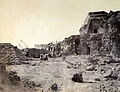 The Jantar Mantar observatory in Delhi in 1858, damaged in the fighting
-
 Mortar damage to Kashmiri Gate, Delhi, 1858
-
 Hindu Rao's house in Delhi, now a hospital, was extensively damaged in the fighting
-
 Bank of Delhi was attacked by mortar and gunfire


The British soon arrested Bahadur Shah, and the next day the British agent William Hodson had his sons Mirza Mughal, Mirza Khazir Sultan, and grandson Mirza Abu Bakr shot under his own authority at the Khooni Darwaza (the bloody gate) near Delhi Gate. On hearing the news Zafar reacted with shocked silence while his wife Zinat Mahal was content as she believed her son was now Zafar's heir.[92] Shortly after the fall of Delhi, the victorious attackers organised a column that relieved another besieged Company force in Agra, and then pressed on to Cawnpore, which had also recently been retaken. This gave the Company forces a continuous, although still tenuous, line of communication from the east to west of India.
Cawnpore (Kanpur)
Main article: Siege of Cawnpore

Tatya Tope's Soldiery

A memorial erected (circa 1860) by the British after the Mutiny at the
Bibighar Well. After India's Independence the statue was moved to the All Souls Memorial Church, Cawnpore. Albumen silver print by Samuel Bourne, 1860
The besieged endured three weeks of the Siege of Cawnpore with little water or food, suffering continuous casualties to men, women and children. On 25 June Nana Sahib made an offer of safe passage to Allahabad. With barely three days' food rations remaining, the British agreed provided they could keep their small arms and that the evacuation should take place in daylight on the morning of the 27th (the Nana Sahib wanted the evacuation to take place on the night of the 26th). Early in the morning of 27 June, the European party left their entrenchment and made their way to the river where boats provided by the Nana Sahib were waiting to take them to Allahabad.[93] Several sepoys who had stayed loyal to the Company were removed by the mutineers and killed, either because of their loyalty or because "they had become Christian." A few injured British officers trailing the column were also apparently hacked to death by angry sepoys. After the European party had largely arrived at the dock, which was surrounded by sepoys positioned on both banks of the Ganges,[94] with clear lines of fire, firing broke out and the boats were abandoned by their crew, and caught or were set[95] on fire using pieces of red hot charcoal.[96] The British party tried to push the boats off but all except three remained stuck. One boat with over a dozen wounded men initially escaped, but later grounded, was caught by mutineers and pushed back down the river towards the carnage at Cawnpore. Towards the end rebel cavalry rode into the water to finish off any survivors.[96] After the firing ceased the survivors were rounded up and the men shot.[96] By the time the massacre was over, most of the male members of the party were dead while the surviving women and children were removed and held hostage to be later killed in The Bibighar massacre.[97] Only four men eventually escaped alive from Cawnpore on one of the boats: two private soldiers, a lieutenant, and Captain Mowbray Thomson, who wrote a first-hand account of his experiences entitled The Story of Cawnpore (London, 1859).
During his trial, Tatya Tope denied the existence of any such plan and described the incident in the following terms: the Europeans had already boarded the boats and Tatya Tope raised his right hand to signal their departure. That very moment someone from the crowd blew a loud bugle, which created disorder and in the ongoing bewilderment, the boatmen jumped off the boats. The rebels started shooting indiscriminately. Nana Sahib, who was staying in Savada Kothi (Bungalow) nearby, was informed about what was happening and immediately came to stop it.[98] Some British histories allow that it might well have been the result of accident or error; someone accidentally or maliciously fired a shot, the panic-stricken British opened fire, and it became impossible to stop the massacre.[99]
The surviving women and children were taken to the Nana Sahib and then confined first to the Savada Kothi and then to the home of the local magistrate's clerk (The Bibigarh)[100] where they were joined by refugees from Fatehgarh. Overall five men and two hundred and six women and children were confined in The Bibigarh for about two weeks. In one week 25 were brought out dead, from dysentery and cholera.[95] Meanwhile, a Company relief force that had advanced from Allahabad defeated the Indians and by 15 July it was clear that the Nana Sahib would not be able to hold Cawnpore and a decision was made by the Nana Sahib and other leading rebels that the hostages must be killed. After the sepoys refused to carry out this order, two Muslim butchers, two Hindu peasants and one of Nana's bodyguards went into The Bibigarh. Armed with knives and hatchets they murdered the women and children.[101] After the massacre the walls were covered in bloody hand prints, and the floor littered with fragments of human limbs.[102] The dead and the dying were thrown down a nearby well. When the 50-foot (15 m) deep well was filled with remains to within 6 feet (1.8 m) of the top,[103] the remainder were thrown into the Ganges.[104]
Historians have given many reasons for this act of cruelty. With Company forces approaching Cawnpore and some believing that they would not advance if there were no hostages to save, their murders were ordered. Or perhaps it was to ensure that no information was leaked after the fall of Cawnpore. Other historians have suggested that the killings were an attempt to undermine Nana Sahib's relationship with the British.[105] Perhaps it was due to fear, the fear of being recognised by some of the prisoners for having taken part in the earlier firings.[97]
-
 Photograph entitled, "The Hospital in General Wheeler's entrenchment, Cawnpore." (1858) The hospital was the site of the first major loss of European lives in Cawnpore
-
 1858 picture of Sati Chaura Ghat on the banks of the Ganges River, where on 27 June 1857 many British men lost their lives and the surviving women and children were taken prisoner by the rebels.
-
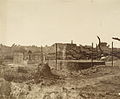 Bibigarh house where European women and children were killed and the well where their bodies were found, 1858.
-
 The Bibighar Well site where a memorial had been built. Samuel Bourne, 1860.


A contemporary image of the massacre at the Satichaura Ghat
Other British accounts[106][107][108] state that indiscriminate punitive measures were taken in early June, two weeks before the murders at the Bibighar (but after those at both Meerut and Delhi), specifically by Lieutenant Colonel James George Smith Neill of the Madras Fusiliers, commanding at Allahabad while moving towards Cawnpore. At the nearby town of Fatehpur, a mob had attacked and murdered the local European population. On this pretext, Neill ordered all villages beside the Grand Trunk Road to be burned and their inhabitants to be killed by hanging. Neill's methods were "ruthless and horrible"[109] and far from intimidating the population, may well have induced previously undecided sepoys and communities to revolt.
Neill was killed in action at Lucknow on 26 September and was never called to account for his punitive measures, though contemporary British sources lionised him and his "gallant blue caps".[110] When the British retook Cawnpore, the soldiers took their sepoy prisoners to the Bibighar and forced them to lick the bloodstains from the walls and floor.[111] They then hanged or "blew from the cannon", the traditional Mughal punishment for mutiny, the majority of the sepoy prisoners. Although some claimed the sepoys took no actual part in the killings themselves, they did not act to stop it and this was acknowledged by Captain Thompson after the British departed Cawnpore for a second time.
Lucknow
Main article: Siege of Lucknow

The interior of the Secundra Bagh, several months after its storming
during the second relief of Lucknow. Albumen silver print by Felice Beato, 1858
On 25 September a relief column under the command of Sir Henry Havelock and accompanied by Sir James Outram (who in theory was his superior) fought its way from Cawnpore to Lucknow in a brief campaign, in which the numerically small column defeated rebel forces in a series of increasingly large battles. This became known as 'The First Relief of Lucknow', as this force was not strong enough to break the siege or extricate themselves, and so was forced to join the garrison. In October another, larger, army under the new Commander-in-Chief, Sir Colin Campbell, was finally able to relieve the garrison and on 18 November, they evacuated the defended enclave within the city, the women and children leaving first. They then conducted an orderly withdrawal, firstly to Alambagh 4 miles (6.4 km) north where a force of 4,000 were left to construct a fort, then to Cawnpore, where they defeated an attempt by Tatya Tope to recapture the city in the Second Battle of Cawnpore.
In March 1858, Campbell once again advanced on Lucknow with a large army, meeting up with the force at Alambagh, this time seeking to suppress the rebellion in Awadh. He was aided by a large Nepalese contingent advancing from the north under Jang Bahadur.[112] Campbell's advance was slow and methodical, with a force under General Outram crossing the river on cask bridges on 4 March to enable them to fire artillery in flank, the forces drove the large but disorganised rebel army from Lucknow with the final fighting shooting on 21 March,[91]:491 there were few casualties to his own troops. This nevertheless allowed large numbers of the rebels to disperse into Awadh, and Campbell was forced to spend the summer and autumn dealing with scattered pockets of resistance while losing men to heat, disease and guerrilla actions.
Jhansi
Main article: Central India Campaign (1858)

Jhansi Fort, which was taken over by rebel forces, and subsequently defended against British recapture by the Rani of Jhansi
By the end of June 1857, the Company had lost control of much of Bundelkhand and eastern Rajasthan. The Bengal Army units in the area, having rebelled, marched to take part in the battles for Delhi and Cawnpore. The many princely states that made up this area began warring amongst themselves. In September and October 1857, the Rani led the successful defence of Jhansi against the invading armies of the neighbouring rajas of Datia and Orchha.
On 3 February, Sir Hugh Rose broke the 3-month siege of Saugor. Thousands of local villagers welcomed him as a liberator, freeing them from rebel occupation.[113]
In March 1858, the Central India Field Force, led by Sir Hugh Rose, advanced on and laid siege to Jhansi. The Company forces captured the city, but the Rani fled in disguise.
After being driven from Jhansi and Kalpi, on 1 June 1858 Rani Lakshmi Bai and a group of Maratha rebels captured the fortress city of Gwalior from the Scindia rulers, who were British allies. This might have reinvigorated the rebellion but the Central India Field Force very quickly advanced against the city. The Rani died on 17 June, the second day of the Battle of Gwalior, probably killed by a carbine shot from the 8th King's Royal Irish Hussars according to the account of three independent Indian representatives. The Company forces recaptured Gwalior within the next three days. In descriptions of the scene of her last battle, she was compared to Joan of Arc by some commentators.[114]
Indore
Colonel Henry Marion Durand, the then-Company resident at Indore, had brushed away any possibility of uprising in Indore.[115] However, on 1 July, sepoys in Holkar's army revolted and opened fire on the pickets of Bhopal Cavalry. When Colonel Travers rode forward to charge, Bhopal Cavalry refused to follow. The Bhopal Infantry also refused orders and instead levelled their guns at European sergeants and officers. Since all possibility of mounting an effective deterrent was lost, Durand decided to gather up all the European residents and escape, although 39 European residents of Indore were killed.[116]Other regions
Punjab

Execution of mutineers at Peshawur
Much of the region had been the Sikh Empire, ruled by Ranjit Singh until his death in 1839. The kingdom had then fallen into disorder, with court factions and the Khalsa (the Sikh army) contending for power at the Lahore Durbar (court). After two Anglo-Sikh Wars, the entire region was annexed by the East India Company in 1849. In 1857, the region still contained the highest numbers of both European and Indian troops.
The inhabitants of the Punjab were not as sympathetic to the sepoys as they were elsewhere in India, which limited many of the outbreaks in the Punjab to disjointed uprisings by regiments of sepoys isolated from each other. In some garrisons, notably Ferozepore, indecision on the part of the senior European officers allowed the sepoys to rebel, but the sepoys then left the area, mostly heading for Delhi.[117] At the most important garrison, that of Peshawar close to the Afghan frontier, many comparatively junior officers ignored their nominal commander (the elderly General Reed) and took decisive action. They intercepted the sepoys' mail, thus preventing their coordinating an uprising, and formed a force known as the "Punjab Movable Column" to move rapidly to suppress any revolts as they occurred. When it became clear from the intercepted correspondence that some of the sepoys at Peshawar were on the point of open revolt, the four most disaffected Bengal Native regiments were disarmed by the two British infantry regiments in the cantonment, backed by artillery, on 22 May. This decisive act induced many local chieftains to side with the British.[118]

Marble Lectern in memory of 35 British soldiers in Jhelum
The final large-scale military uprising in the Punjab took place on 9 July, when most of a brigade of sepoys at Sialkot rebelled and began to move to Delhi. They were intercepted by John Nicholson with an equal British force as they tried to cross the Ravi River. After fighting steadily but unsuccessfully for several hours, the sepoys tried to fall back across the river but became trapped on an island. Three days later, Nicholson annihilated the 1,100 trapped sepoys in the Battle of Trimmu Ghat.[119]
The British had been recruiting irregular units from Sikh and Pakhtun communities even before the first unrest among the Bengal units, and the numbers of these were greatly increased during the Rebellion, 34,000 fresh levies eventually being raised.[120]
At one stage, faced with the need to send troops to reinforce the besiegers of Delhi, the Commissioner of the Punjab (Sir John Lawrence) suggested handing the coveted prize of Peshawar to Dost Mohammed Khan of Afghanistan in return for a pledge of friendship. The British Agents in Peshawar and the adjacent districts were horrified. Referring to the massacre of a retreating British army in 1842, Herbert Edwardes wrote, "Dost Mahomed would not be a mortal Afghan ... if he did not assume our day to be gone in India and follow after us as an enemy. Europeans cannot retreat – Kabul would come again."[121] In the event Lord Canning insisted on Peshawar being held, and Dost Mohammed, whose relations with Britain had been equivocal for over 20 years, remained neutral.

Bihar
See also: Siege of Arrah
Kunwar Singh, the 80-year-old Rajput Zamindar of Jagdispur,
whose estate was in the process of being sequestrated by the Revenue
Board, instigated and assumed the leadership of revolt in Bihar.[123]On 25 July, mutiny erupted in the garrisons of Dinapur. Mutinying sepoys from the 7th, 8th and 40th regiments of Bengal Native Infantry quickly moved towards the city of Arrah and were joined by Kunwar Singh and his men.[124] Mr. Boyle, a British railway engineer in Arrah, had already prepared an outbuilding on his property for defence against such attacks.[125] As the rebels approached Arrah, all European residents took refuge at Mr. Boyle's house.[126] A siege soon ensued - eighteen civilians and 50 loyal sepoys from the Bengal Military Police Battalion under the command of Herwald Wake, the local magistrate, defended the house against artillery and musketry fire from an estimated 2000 to 3000 mutineers and rebels.[127]
On 29 July 400 men were sent out from Dinapore to relieve Arrah, but this force was ambushed by the rebels around a mile away from the siege house, severely defeated, and driven back. On 30 July, Major Vincent Eyre, who was going up the river with his troops and guns, reached Buxar and heard about the siege. He immediately disembarked his guns and troops (the 5th Fusiliers) and started marching towards Arrah, disregarding direct orders not to do so.[128] On 2 August, some 6 miles (9.7 km) short of Arrah, the Major was ambushed by the mutineers and rebels. After an intense fight, the 5th Fusiliers charged and stormed the rebel positions successfully.[127] On 3 August, Major Eyre and his men reached the siege house and successfully ended the siege.[129][130]
After receiving reinforcements Major Eyre pursued Kunwar Singh to his palace in Jagdispur, however Singh had left by the time Eyre's forces arrived. Eyre then proceeded to destroy the palace and the homes of Singh's brothers.[127]
Bengal and Tripura
In September 1857, sepoys took control of the treasury in Chittagong.[131] The treasury remained under rebel control for several days. Further mutinies on 18 November saw the 2nd, 3rd and 4th companies of the 34th Bengal Infantry Regiment storming the Chittagong Jail and releasing all prisoners. The mutineers were eventually suppressed by the Gurkha regiments.[132] The mutiny also spread to Dacca, the former Mughal capital of Bengal. Residents in the city's Lalbagh area were kept awake at night by the rebellion.[133] Sepoys joined hands with the common populace in Jalpaiguri to take control of the city's cantonment.[131] In January 1858, many sepoys received shelter from the royal family of the princely state of Hill Tippera.[131]The interior areas of Bengal proper were already experiencing growing resistance to Company rule due to the Muslim Faraizi movement.[131]
British Empire
The authorities in British colonies with an Indian population, sepoy or civilian, took measures to secure themselves against copycat uprisings. In the Straits Settlements, and Trinidad the annual Hosay processions were banned,[134] riots broke out in penal settlements in Burma, and the Settlements, in Penang the loss of a musket provoked a near riot,[135] and security was boosted especially in locations with an Indian convict population.[136]Aftermath

"The Relief of Lucknow" by Thomas Jones Barker
Most of the British press, outraged by the stories of rape and the killings of civilians and wounded British soldiers, did not advocate clemency of any kind. Governor General Canning ordered moderation in dealing with native sensibilities and earned the scornful sobriquet "Clemency Canning" from the press[138] and later parts of the British public.
In terms of sheer numbers, the casualties were much higher on the Indian side. A letter published after the fall of Delhi in the "Bombay Telegraph" and reproduced in the British press testified to the scale of the Indian casualties:
.... All the city's people found within the walls of the city of Delhi when our troops entered were bayoneted on the spot, and the number was considerable, as you may suppose, when I tell you that in some houses forty and fifty people were hiding. These were not mutineers but residents of the city, who trusted to our well-known mild rule for pardon. I am glad to say they were disappointed.[139]

British soldiers looting Qaisar Bagh, Lucknow, after its recapture (steel engraving, late 1850s)
Edward Vibart, a 19-year-old officer whose parents, younger brothers, and two of his sisters had died in the Cawnpore massacre,[140] recorded his experience:
The orders went out to shoot every soul.... It was literally murder... I have seen many bloody and awful sights lately but such a one as I witnessed yesterday I pray I never see again. The women were all spared but their screams on seeing their husbands and sons butchered, were most painful... Heaven knows I feel no pity, but when some old grey bearded man is brought and shot before your very eyes, hard must be that man's heart I think who can look on with indifference...[141]

Blowing from a gun, 8 September 1857
The aftermath of the rebellion has been the focus of new work using Indian sources and population studies. In The Last Mughal, historian William Dalrymple examines the effects on the Muslim population of Delhi after the city was retaken by the British and finds that intellectual and economic control of the city shifted from Muslim to Hindu hands because the British, at that time, saw an Islamic hand behind the mutiny.[142]
Reaction in Britain

Justice, a print by Sir John Tenniel in a September 1857 issue of Punch
Incidents of rape allegedly committed by Indian rebels against European women and girls appalled the British public. These atrocities were often used to justify the British reaction to the rebellion. British newspapers printed various eyewitness accounts of the rape of English women and girls. One such account was published by The Times, regarding an incident where 48 English girls as young as 10 had been raped by Indian rebels in Delhi. Karl Marx considered this story as false propaganda, and pointed out that the story was written by a clergyman in Bangalore, far from the events of the rebellion, with no evidence to support his allegation.[145] Individual incidents captured the public's interest and were heavily reported by the press. One such incident was that of General Wheeler's daughter Margaret being forced to live as her captor's concubine, though this was reported to the Victorian public as Margaret killing her rapist then herself.[146] Another version of the story suggested that Margaret had been killed after her abductor had argued with his wife over her.[147]
During the aftermath of the rebellion, a series of exhaustive investigations were carried out by British police and intelligence officials into reports that British women prisoners had been "dishonored" at the Bibighar and elsewhere. One such detailed enquiry was at the direction of Lord Canning. The consensus was that there was no convincing evidence of such crimes having been committed, although numbers of European women and children had been killed outright.[148]
Long after the political recovery was done, women were the focal point and symbol of any distrust the British had in India. Women's "fragile female bodies" were violated by the mutiny's incidents of rape and Britain immediately reacted in "vicious...reprisals against the local population." However, Indian women at the time are still undocumented from the "official male sources." Further research could lend insight to both sides of the situation during the rebellion of 1857.[149]
The term 'Sepoy' or 'Sepoyism' became a derogatory term for nationalists especially in Ireland.[150]
Reorganisation

Bahadur Shah Zafar (the last Mughal emperor) in Delhi, awaiting trial by the British for his role in the Uprising. Photograph by Robert Tytler and Charles Shepherd, May 1858
The rebellion saw the end of the East India Company's rule in India. In August, by the Government of India Act 1858, the company was formally dissolved and its ruling powers over India were transferred to the British Crown.[151] A new British government department, the India Office, was created to handle the governance of India, and its head, the Secretary of State for India, was entrusted with formulating Indian policy. The Governor-General of India gained a new title, Viceroy of India, and implemented the policies devised by the India Office. Some former East India Company territories, such as the Straits Settlements, became colonies in their own right. The British colonial administration embarked on a program of reform, trying to integrate Indian higher castes and rulers into the government and abolishing attempts at Westernization. The Viceroy stopped land grabs, decreed religious tolerance and admitted Indians into civil service, albeit mainly as subordinates.
Essentially the old East India Company bureaucracy remained, though there was a major shift in attitudes. In looking for the causes of the Rebellion the authorities alighted on two things: religion and the economy. On religion it was felt that there had been too much interference with indigenous traditions, both Hindu and Muslim. On the economy it was now believed that the previous attempts by the Company to introduce free market competition had undermined traditional power structures and bonds of loyalty placing the peasantry at the mercy of merchants and money-lenders. In consequence the new British Raj was constructed in part around a conservative agenda, based on a preservation of tradition and hierarchy.
On a political level it was also felt that the previous lack of consultation between rulers and ruled had been another significant factor in contributing to the uprising. In consequence, Indians were drawn into government at a local level. Though this was on a limited scale a crucial precedent had been set, with the creation of a new 'white collar' Indian elite, further stimulated by the opening of universities at Calcutta, Bombay and Madras, a result of the Indian Universities Act. So, alongside the values of traditional and ancient India, a new professional middle class was starting to arise, in no way bound by the values of the past. Their ambition can only have been stimulated by Queen Victoria's Proclamation of November 1858, in which it is expressly stated, "We hold ourselves bound to the natives of our Indian territories by the same obligations of duty which bind us to our other subjects...it is our further will that... our subjects of whatever race or creed, be freely and impartially admitted to offices in our service, the duties of which they may be qualified by their education, ability and integrity, duly to discharge."
Acting on these sentiments, Lord Ripon, viceroy from 1880 to 1885, extended the powers of local self-government and sought to remove racial practices in the law courts by the Ilbert Bill. But a policy at once liberal and progressive at one turn was reactionary and backward at the next, creating new elites and confirming old attitudes. The Ilbert Bill had the effect only of causing a white mutiny and the end of the prospect of perfect equality before the law. In 1886 measures were adopted to restrict Indian entry into the civil service.
Military reorganisation
See also: Pattern 1853 Enfield

Captain C Scott of the Gen. Sir. Hope Grant's Column, Madras Regiment, who fell on the attack of Fort of Kohlee, 1858. Memorial at the St. Mary's Church, Madras
The rebellion transformed both the native and European armies of British India. Of the 74 regular Bengal Native Infantry regiments in existence at the beginning of 1857, only twelve escaped mutiny or disbandment.[154] All ten of the Bengal Light Cavalry regiments were lost. The old Bengal Army had accordingly almost completely vanished from the order of battle. These troops were replaced by new units recruited from castes hitherto under-utilised by the British and from the minority so-called "Martial Races", such as the Sikhs and the Gurkhas.
The inefficiencies of the old organisation, which had estranged sepoys from their British officers, were addressed, and the post-1857 units were mainly organised on the "irregular" system. From 1797 until the rebellion of 1857, each regular Bengal Native Infantry regiment had had 22 or 23 British officers,[155] who held every position of authority down to the second-in-command of each company. In irregular units there were fewer European officers, but they associated themselves far more closely with their soldiers, while more responsibility was given to the Indian officers.
The British increased the ratio of British to Indian soldiers within India. From 1861 Indian artillery was replaced by British units, except for a few mountain batteries.[156] The post-rebellion changes formed the basis of the military organisation of British India until the early 20th century.
Awards
 Victoria Cross

 Indian Mutiny Medal

 Indian Order of Merit

Nomenclature
See also: First War of Indian Independence (term)
There is no universally agreed name for the events of this period.In India and Pakistan it has been termed as the "War of Independence of 1857" or "First War of Indian Independence"[159] but it is not uncommon to use terms such as the "Revolt of 1857". The classification of the Rebellion being "First War of Independence" is not without its critics in India.[160][161][162][163] The use of the term "Indian Mutiny" is considered by some Indian politicians[164] as belittling the importance of what happened and therefore reflecting an imperialistic attitude. Others dispute this interpretation.
In the UK and parts of the Commonwealth it is commonly called the "Indian Mutiny", but terms such as "Great Indian Mutiny", the "Sepoy Mutiny", the "Sepoy Rebellion", the "Sepoy War", the "Great Mutiny", the "Rebellion of 1857", "the Uprising", the "Mahomedan Rebellion", and the "Revolt of 1857" have also been used.[165][166][167] "The Indian Insurrection" was a name used in the press of the UK and British colonies at the time.[168]
Historiography

The Mutiny Memorial in Delhi, a monument to those killed on the British side during the fighting.
Christopher Bayly (1945 – 2015) wrote at length on India, especially in world and comparative perspective. For example, he explored the similarities of India and Ireland under British rule in the mid-19th century, with an emphasis on how the British Empire transformed or ruined their economies through policies of rapid industrialization, free trade, and the intrusion of the modern state. In 1800 they both were old agroindustrial provinces; both then underwent rapid deindustrialization. The main reason was plunging European demand for their exports, coupled with imposition of free trade starting in 1801 for Ireland and in 1834 in India. Bayly concludes that powerful nationalist slogans of 'swadeshi' in Gandhi's India and "home production` in Ireland were not echoes of a reinvented mythical past, but a practical reaction to recent economic disasters.[172]

Sepoy Mutiny Execution by Blowing from a gun
Professor Kim Wagner has the most recent survey of the historiography, and stresses the importance of William Dalrymple’s The Last Mughal: The Fall of a Dynasty, Delhi 1857. Dalrymple was assisted by Mahmood Farooqui, who translated key Urdu and Shikastah sources and published a selection in Besieged: Voices from Delhi 1857.[174] Dalrymple emphasized the role of religion, and explored in detail the internal divisions and politico-religious discord amongst the rebels. He did not discover much in the way of proto-nationalism or any of the roots of modern India in the rebellion.[175][176] Sabbaq Ahmed has looked at the ways in which ideologies of royalism, militarism, and Jihad influenced the behaviour of contending Muslim factions.[177]
Almost from the moment the first sepoys mutinied in Meerut, the nature and the scope of the Indian Rebellion of 1857 has been contested and argued over. Speaking in the House of Commons in July 1857, Benjamin Disraeli labelled it a 'national revolt' while Lord Palmerston, the Prime Minister, tried to downplay the scope and the significance of the event as a 'mere military mutiny'.[178] Reflecting this debate, an early historian of the rebellion, Charles Ball, used the word mutiny in his title, but labelled it a 'struggle for liberty and independence as a people' in the text.[179] Historians remain divided on whether the rebellion can properly be considered a war of Indian independence or not,[180] although it is popularly considered to be one in India. Arguments against include:
- A united India did not exist at that time in political, cultural, or ethnic terms;
- The rebellion was put down with the help of other Indian soldiers drawn from the Madras Army, the Bombay Army and the Sikh regiments; 80% of the East India Company forces were Indian;[181]
- Many of the local rulers fought amongst themselves rather than uniting against the British;
- Many rebel Sepoy regiments disbanded and went home rather than fight;
- Not all of the rebels accepted the return of the Mughals;
- The King of Delhi had no real control over the mutineers;[182]
- The revolt was largely limited to north and central India. Whilst risings occurred elsewhere they had little impact because of their limited nature;
- A number of revolts occurred in areas not under British rule, and against native rulers, often as a result of local internal politics;
- The revolt was fractured along religious, ethnic and regional lines.[183]

The hanging of two participants in the Indian Rebellion, Sepoys of the 31st Native Infantry. Albumen silver print by Felice Beato, 1857
- Even though the rebellion had various causes, most of the rebel sepoys who were able to do so, made their way to Delhi to revive the old Mughal empire that signified national unity for even the Hindus amongst them;
- There was a widespread popular revolt in many areas such as Awadh, Bundelkhand and Rohilkhand. The rebellion was therefore more than just a military rebellion, and it spanned more than one region;
- The sepoys did not seek to revive small kingdoms in their regions, instead they repeatedly proclaimed a "country-wide rule" of the Mughals and vowed to drive out the British from "India", as they knew it then. (The sepoys ignored local princes and proclaimed in cities they took over: Khalq Khuda Ki, Mulk Badshah Ka, Hukm Subahdar Sipahi Bahadur Ka – "the people belong to God, the country to the Emperor and authority to the Sepoy Commandant"). The objective of driving out "foreigners" from not only one's own area but from their conception of the entirety of "India", signifies a nationalist sentiment;
- The mutineers, although some were recruited from outside Oudah, displayed a common purpose.[184]
150th anniversary
The Government of India celebrated the year 2007 as the 150th anniversary of "India's First War of Independence". Several books written by Indian authors were released in the anniversary year including Amresh Mishra's "War of Civilizations", a controversial history of the Rebellion of 1857, and "Recalcitrance" by Anurag Kumar, one of the few novels written in English by an Indian based on the events of 1857.In 2007, a group of retired British soldiers and civilians, some of them descendants of British soldiers who died in the conflict, attempted to visit the site of the Siege of Lucknow. However, fears of violence by Indian demonstrators, supported by the Hindu nationalist Bharatiya Janata Party, prevented the British visitors from visiting the site.[185] Despite the protests, Sir Mark Havelock was able to make his way past police to visit the grave of his ancestor, General Henry Havelock.[186]
In popular culture

Henry Nelson O'Neil's 1857 painting Eastward Ho! depicting British soldiers say farewell to their loved ones as they embark on a deployment to India.
Films
- Shatranj Ke Khilari – A 1977 Indian film directed by Satyajit Ray, chronicling the events just before the onset of the Sepoy Mutiny of 1857. The focus is on the British annexation of Oudh, and the detachment of the nobility from the political sphere in 19th century India.
- Junoon (1978 film) – Directed by Shyam Benegal, it is a critically acclaimed film about the love affair between a Pathan feudal chief and a British girl sheltered by his family during the revolt.
- Mangal Pandey: The Rising (2005) – Ketan Mehta's Hindi film chronicles the life of Mangal Pandey.
- The Charge of the Light Brigade (1936) features a sequence inspired by the massacre at Cawnpore.
- Indiana Jones and the Temple of Doom - During the dinner scene at the fictional Pankot Palace, Indiana Jones mentions that Captain Blumburtt was telling him about the role which the palace played in "the mutiny" and Chattar Lal complains, "It seems the British never forget the Mutiny of 1857".
- The Last Cartridge, an Incident of the Sepoy Rebellion in India (1908) - A fictionalized account of a British fort besieged during the Rebellion.
Theatre
- 1857: Ek Safarnama – A play by Javed Siddiqui, set during the Rebellion of 1857 and staged at Purana Qila, Delhi.[187]
Literature
- Malcolm X's autobiography The Autobiography of Malcolm X details his first encounters with atrocities in the non-European world and his reaction to the rebellion and massacres in 1857.
- John Masters's novel Nightrunners of Bengal, first published by Michael Joseph in 1951 and dedicated to the Sepoy of India, is a fictionalised account of the Rebellion as seen through the eyes of a British Captain in the Bengal Native Infantry who was based in Bhowani, itself a fictionalised version of the town of Jhansi. Captain Savage and his turbulent relationship with the Rani of Kishanpur form an analogous interrelationship of the Indian people and the British and sepoy regiments at that time.
- J. G. Farrell's 1973 novel The Siege of Krishnapur details the siege of the fictional Indian town of Krishnapur during the Rebellion.
- George MacDonald Fraser's 1975 novel Flashman in the Great Game deals with the events leading up to and during the Rebellion.
- Two of Sir Arthur Conan Doyle's Sherlock Holmes stories, The Sign of the Four and "The Adventure of the Crooked Man," feature events that took place during the Rebellion.
- Michael Crichton's 1975 novel The Great Train Robbery mentions the Rebellion and briefly details the events of the Siege of Cawnpore, as the Rebellion was happening in tandem with the trial of Edward Pierce.[188]
- The majority of M. M. Kaye's novel Shadow of the Moon is set between 1856–58, and the Rebellion is shown to greatly affect the lives of the main characters, who were inhabitants of the Residency at Lunjore (a fictional town in north India). The early chapters of her novel The Far Pavilions take place during the Rebellion, which leads to the protagonist, a child of British ancestry, being raised as a Hindu.
- Indian writer Ruskin Bond's fictional novella A Flight of Pigeons is set around the Indian Rebellion of 1857. It is from this story that the film Junoon was later adapted in 1978 by Shyam Benegal.
- The 1880 novel The Steam House by Jules Verne takes place in the aftermath of the Indian Rebellion of 1857.
- Jules Verne's famous character Captain Nemo, originally an Indian prince, fought on the side of the rebels during the rebellion (as stated in Verne's later novel The Mysterious Island).
- E. M. Forster's 1924 novel A Passage to India alludes several times to the Mutiny.
- Flora Annie Steel's novel On the Face of the Waters (1896) describes incidents of the Mutiny.
- The plot of H. Beam Piper's science fiction novel Uller Uprising is based on the events of the Indian Rebellion of 1857.
- Rujub, the juggler and In Times of Peril: A tale of India by G.A. Henty are each based on the Indian Rebellion of 1857[117][117]
See also

- Indian National Army, composed of British Indian prisoners of war during World War II which fought for a independent state of India
- Political warfare in British colonial India
- Bengal Native Infantry
- Barrackpore Mutiny of 1824
Notes

- The Great Train Robbery (1st ed.). Ballantine Books. 1975. pp. 272–275, 278, 280.